You've probably heard that certain ingredients, like retinol, salicylic acid, or parabens, should be avoided or limited during pregnancy. But there's one ingredient that appears on nearly every product label, and it's hiding in plain sight.
Fragrance.
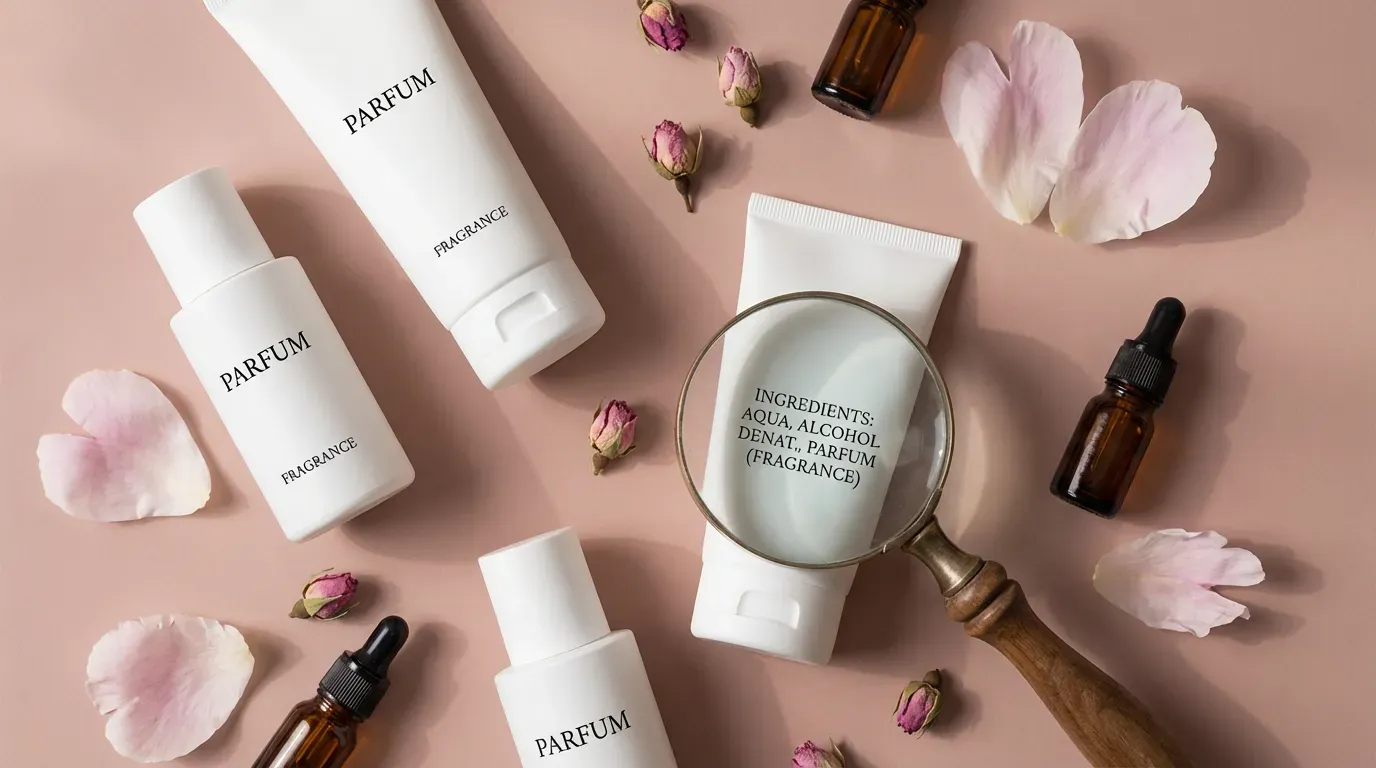
It sounds harmless, right? Sometimes it's listed as "fragrance," sometimes as "parfum." It's just the thing that makes your moisturiser smell like roses or your shampoo smell like coconut. What's the big deal?
Here's the thing: "fragrance" isn't one ingredient. It's a catch-all term that can represent dozens, sometimes hundreds, of undisclosed chemicals.
And while many of them are perfectly safe, some have been linked to hormone disruption, reproductive toxicity, and other concerns that are particularly relevant when you're trying to conceive or pregnant.
Why is fragrance such a mystery?
In the UK and EU, cosmetic companies are allowed to list "fragrance" or "parfum" as a single ingredient, even if the actual fragrance blend contains 50+ individual chemicals. This is treated as a trade secret to protect proprietary formulas.
The problem? You have no idea what you're actually putting on your skin.
That floral body lotion could contain:
- Phthalates (linked to endocrine disruption)
- Synthetic musks (which can accumulate in the body over time)
- Allergens (EU law requires disclosure for the top 26, but that's it)
- Other chemicals that simply haven't been studied enough in the context of pregnancy and fertility
Some fragrance ingredients are totally fine. Others are worth avoiding or limiting, especially during TTC and pregnancy when hormone balance and fetal development are so critical.
The issue isn't fragrance itself. It's the lack of transparency.
What does this mean for you?
If you're trying to conceive or pregnant, you're likely being extra cautious about what you use. And you should be! But "fragrance" makes that nearly impossible.
Here's what makes this so frustrating:
- You can't make an informed choice if you don't know what's in the product
- Not all fragrance is bad, but you're left guessing
- Even "pregnancy-safe" or "clean beauty" brands may still use undisclosed fragrance blends
You might think, "I'll just avoid anything with fragrance on the label." That's one approach, but it's not always realistic, and it might mean giving up products that are actually fine.
What you really need is a way to assess products on a case-by-case basis, rather than operating in the dark.
The bigger picture
Fragrance is just one example of a much larger issue: ingredient transparency in the beauty and personal care industry is shockingly poor.
Cosmetic companies aren't required to prove safety before a product hits the shelves. They aren't required to disclose full ingredient breakdowns. And they certainly aren't required to consider how ingredients might affect fertility, pregnancy, or long-term hormonal health.
That burden falls on you, the person already juggling a million other things while trying to conceive or grow a baby.
It shouldn't be this hard.
What you can do
While we can't change the labelling laws overnight, we can change how you navigate them.
Here are some practical steps:
Look for "fragrance-free" or "unscented" products. These won't have added fragrance at all. Just note that "unscented" can sometimes mean a masking fragrance has been added to cover the natural smell of ingredients, so "fragrance-free" is the safer bet.
Choose products scented with named essential oils. If a product lists specific essential oils (like "lavender oil" or "sweet orange oil") instead of just "fragrance," you at least know what you're getting. That said, not all essential oils are suitable for pregnancy, so it's still worth checking.
Prioritise transparency. Brands that are open about their ingredients and formulations are more likely to be trustworthy. Look for companies that go beyond the minimum legal requirements and actually list what's in their products.
That said, navigating this on your own is time-consuming and imperfect. Even "natural" or "clean" products can contain ingredients worth limiting during TTC or pregnancy, and without an ingredient-by-ingredient assessment, you're still left guessing.
That's why we're building PregSafe: a pregnancy-focused ingredient database that lets you scan products, understand what's flagged and why, and make informed choices without the hours of research. Join our waitlist to be the first to know when the app goes live.
PregSafe is not a replacement for medical advice. Always consult your healthcare provider for personalised guidance.